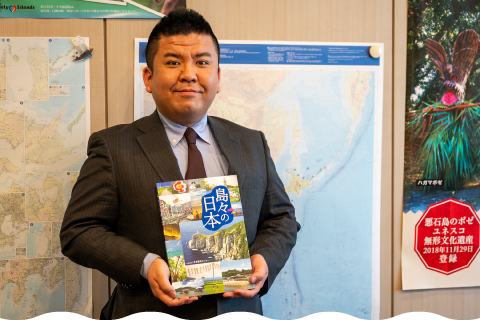
A.The Center for Research and Promotion of Japanese Islands was established in 1966 as a central organization for promoting the development of Japanese islands, and it will celebrate its 60th anniversary in 2026. Composed of municipalities nationwide with islands within their jurisdiction, our current membership totals 136 municipalities. In addition to organizing the "Islander" event to promote the appeal of islands, the Center publishes and distributes the quarterly magazine "Shima", which features information from various regions; conducts research and studies on islands; makes policy recommendations; and organizes lectures, seminars, and workshops. Furthermore, we operate a grant program to support people working on islands. We believe that actively supporting local initiatives and the activities of islanders are our fundamental roles.

A.I was born and raised in a town facing the Seto Inland Sea. After spending my student years in Kansai, I joined the Center for Research and Promotion of Japanese Islands. Since joining the Center, I have been responsible for collecting, organizing, and disseminating information about islands around the country. This includes working on the Japanese island guide "SHIMADAS" (published in 2019) and editing the "Islands Statistical Yearbook", which compiles statistics for individual islands. I also frequently visit islands for workshops, meetings, and other opportunities. While I often travel to islands for my work, I make a conscious effort to deepen my understanding of islands, not just for work-related reasons, but in my daily life as well.
A.When I was in school, I didn't give much thought to my career path. While I had a vague interest in regional issues, I wasn't focused on a specific region; instead, I wanted to be involved in work that connected different regions. It was at this time that a friend who knew me well told me about the Center, sparking my interest in it. I've worked here ever since. Incidentally, that friend of mine owned a copy of the 2004 edition of "SHIMADAS", published before I joined the Center. They even came to the launch of the 2019 edition at the "Islander" event, which promotes the appeal of islands (laughs).
A.In addition to gathering information about islands and editing various publications, I also deal with media inquiries. When people search for information about islands, they often end up on the Center's website, "Shima Shima Net". My work involves gathering information that can be provided to those who inquire with us, organizing it, and disseminating it. I am also responsible for the foundation's projects, including workshops for islanders and events to expand product sales channels.
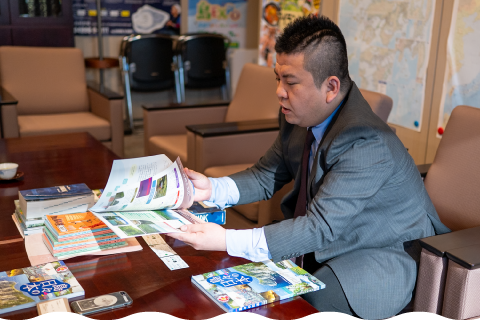
A.My involvement in editing a booklet compiling information about islands is especially memorable to me. Published in 2019, the Japanese island guide "SHIMADAS" aims to offer a comprehensive view of the island nation of Japan through its islands, featuring not only inhabited islands nationwide but also uninhabited islands wherever possible. We sifted through vast amounts of data collected by senior colleagues and provided by islanders, and was able to complete it after many years of work. This experience cultivated my perspective for comparing islands from various angles, forming the foundation of my current work. The free booklet "The Islands of Japan", created in 2023, was designed to introduce the appeal of islands to more people. In collaboration with photographers and a map company, we created a visually-focused, easy-to-understand booklet. It is distributed free of charge upon request, and this initiative continues to this day.
* Click here to request the free booklet"The Islands of Japan"
A.There isn't actually a clear-cut definition. However, the word "island" itself refers to "land surrounded by water". Generally, landmasses that are smaller than the Australian continent are considered islands. Therefore, all the landmasses that make up Japan are considered islands. On top of that, the Center defines the four large islands of Hokkaido, Honshu, Shikoku, and Kyushu, as well as Okinawa Island (the main island of Okinawa) as mainland Japan, and considers all other smaller landmasses to be islands.
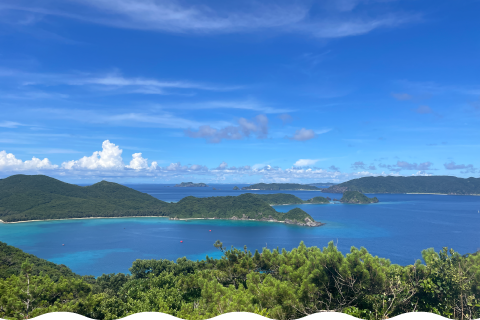
A.Islands have three main roles based on their characteristics. The first is "role based on geographical characteristics". Japan's borders are composed entirely of islands. The presence of islands secures Japan's territorial waters and exclusive economic zones. While Japan ranks 61st globally in terms of land area, its ranking rises significantly when maritime areas are included. This has immense geographical significance. The second is "role based on natural characteristics". Islands possess diverse natural environments and nurture endemic and rare flora and fauna, thereby contributing to expanding Japan's biodiversity. Three out of Japan's five World Natural Heritage sites are located on islands. Seaweed forests, tidal flats, forests, and farmland help purify and maintain the environment, keeping the air and water clean. Furthermore, they provide locations such as the sea for natural recreation, tourism, relaxation, and environmental education, contributing to healthy physical and mental development. The third is "role based on cultural significance". Diverse cultures thrive on islands, and they are home to numerous unique festivals, customs, valuable structures, and art and crafts. They also serve as places for experiential learning and mutual exchanges that leverage local culture. While the designation and registration of cultural properties are important in and of themselves, we believe that in doing so, the process of reviewing regions and rediscovering their value also holds significant meaning.
A.Okinotorishima and Minamitorishima are exceptionally important islands, particularly in terms of their "geographical characteristics". They serve as indispensable bases for securing Japan's exclusive economic zone, and their role stands out even in comparison to the other islands. Although I have never been to either island, I understand that they hold significant potential when it comes to nature, including in terms of wildlife and resources. While Japan's other islands also play important roles, I feel the existence of Okinotorishima and Minamitorishima is particularly consequential. I'm keenly interested in the research projects and symposiums concerning both islands that are being conducted by the Tokyo Metropolitan Government.
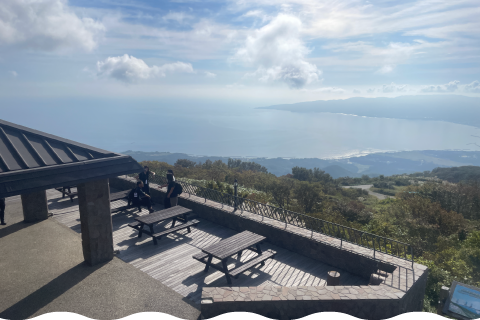
A.It's difficult for me to choose the island that left the most lasting impression on me, but I visited Sado Island in Niigata Prefecture three times this year. We also have Sado rice and fruits on the dinner table at home. It is Japan's largest inhabited island, and it offers new discoveries every time I come into contact with the diversity of the region and the breadth of its industries. It was also registered as a World Heritage Site in 2024. Islands are not just for tourism; they also encompass industries, ways of life, and many other facets. I'm deeply interested in perspectives such as industries that exist on islands, the way islanders lead their lives, and how local resources are utilized. For example, I hear stories about how marine environments are changing, and how different types of fish are being caught. When it comes to strategies for dealing with new fish species, examples I've seen and heard about on other islands can sometimes be helpful. I believe that connecting islands in this way is our role.
A.Whether it's traveling for work or with family and friends, the way I spend time when visiting an island varies depending on the situation, but what I value most is "enjoying the journey". I see traveling by boat or plane not just as a means to an end, but as part of the journey, a gateway to learning more about an island. Once I arrive at an island, the first thing I do is head to the highest point with the best view possible. I survey the entire island from the top of a mountain or hill, using the view to plan where to go next. Since the topography of islands is simple, I highly recommend getting a bird eye's view of islands. When I'm visiting an island, I also value traveling flexibly, without packing my schedule with too many enngagements. If there's a festival or event happening, I actively participate in these events. I encourrage everyone to experience island culture without being constrained by time.
A.I make a point of reviewing articles about the island that were featured in SHIMADAS and the quarterly magazine Shima before visiting an island. While it's certainly important to make new discoveries on the island itself, I find that visiting an island after absorbing information beforehand can lead to deeper insights.

A.Since I don't live on an island myself, I can only offer the perspective of someone who doesn't live on an island. I believe their appeal lies in the fact that they are filled with "unknown things" and "things that haven't been experienced". Islands offer environments where we can break free from the monotony of daily life and engage new things with curiosity. Furthermore, each island has its own culture and way of life, and I believe this diversity contributes to the richness of Japan as a whole. The appeal of islands isn't just about their nature and scenery — it's also about the charm of the resilient islanders who live there. Islanders lead remarkable multifaceted lives, juggling multiple roles instead of just doing a single job. They also face the inevitabilities of life — like dealing with nature or having to rely on sea routes for travel — with acceptance. I find that flexibility and strength of islanders truly captivating.
A.There are many inhabited islands in Tokyo, such as the Izu Islands and the Ogasawara Islands. While some may feel that the hurdle is high, I encourage you to visit these islands and experience their unique charm for yourself. Moreover, there are direct flights from Tokyo to islands like Amami and Okinawa, making it a region with excellent access to islands throughout Japan. It is a prime location as a base for traveling not only to Tokyo's islands, but also to islands throughout Japan. Events celebrating Japan's islands, such as the "Islander" event we organize every November, are frequently held in Tokyo. I encourage you to participate in these events. You're sure to discover something new.


 The official website of the Tokyo Metropolitan Government
 The official website of the Tokyo Metropolitan Government