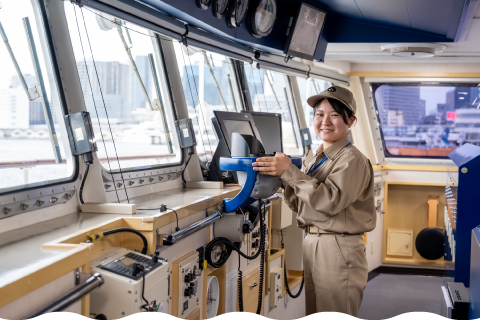
A.I am originally from Nagasaki and grew up in a region with many remote islands. I often had opportunities to travel by ferry between the mainland and the islands, and during those trips I found myself thinking, "It's fun to be on a ship!" That experience sparked a vague interest in a career related to ships. When considering my future studies, I initially looked into universities specializing in maritime education. In the end, however, I chose the Faculty of Fisheries at Nagasaki University, my local university. After enrolling, I learned that by graduating with the required credits at Nagasaki University's Faculty of Fisheries and then completing the required coursework in the advanced program at Tokyo University of Marine Science and Technology, I could obtain a navigation officer's license. From that point on, I began seriously pursuing a career as a navigation officer. When it came time to find employment, I had always hoped to work aboard a university training ship. However, there were no openings at the time, so I decided to work elsewhere and gain experience as a navigation officer while waiting for an opportunity. Later, I found a recruitment announcement for crew members of a training ship operated by Tokyo University of Marine Science and Technology. I applied immediately, was hired, and have continued in that role ever since.
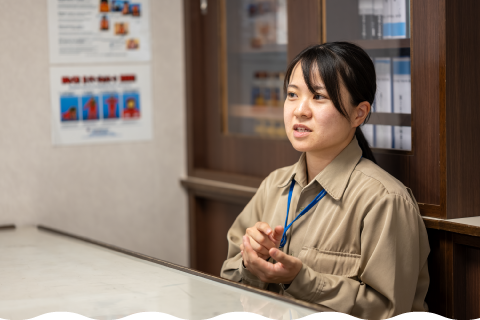
A.Before becoming a navigation officer, my image of the sea was mainly that it was beautiful and calm. Once I began working at sea, however, I came to see it as something with many different faces, not just a peaceful one. As a navigation officer, my attention naturally shifted toward navigation and safety management as well. As a result, I developed a more realistic and multifaceted understanding of the sea.
A.In my hometown of Nagasaki, maritime-related work is familiar to many people, so they generally understand my job quite easily. Friends in Tokyo, however, often ask, "What exactly does a navigation officer do?" To make it easier to understand, I usually explain it simply as "a job where I operate a ship." When I put it that way, people often respond with, "Wow, that's amazing!"
A.A training ship is a vessel used for education, research, and scientific surveys, and SHINYO MARU primarily serves three functions. The first is conducting fisheries training exercises. These include trawling, longline fishing, squid fishing, and similar activities. The second is educating students who aspire to become navigation officers. This involves onboard lectures and practical training using the ship's actual equipment, helping students obtain maritime officer qualifications. The third is carrying out oceanographic observations and research. Researchers come aboard to study marine environments and other characteristics of designated sea areas.
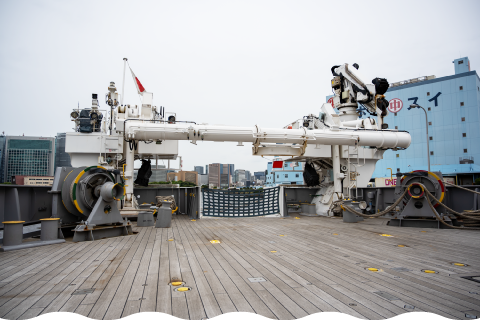
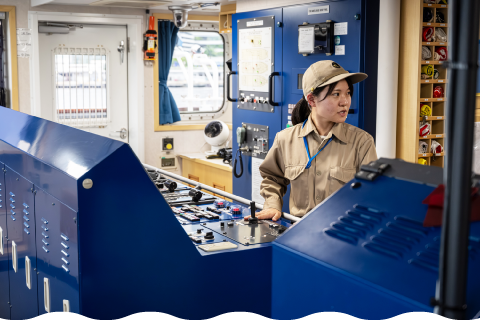
A.My primary responsibility is standing navigational watch while the vessel is underway. During watchkeeping, I maintain a lookout to avoid collisions with other vessels and monitor the surrounding environment from the bridge to ensure safe navigation along the planned route. During oceanographic observations, I am also responsible for maneuvering the vessel and maintaining its position at the observation site. We work on a three-watch rotation system, changing watches every four hours. The schedule follows a cycle of four hours on duty, followed by eight hours off duty. For example, I might stand watch from midnight to 4:00 AM, sleep in the early morning, and then return to duty later in the day. It is a rather unique lifestyle with an irregular daily rhythm, but you gradually get used to it. That said, when I return to shore after a long voyage, I sometimes experience something similar to jet lag! (laughs)
A.Many students are surprised by how normal and comfortable life onboard actually is. The ship is equipped with private cabins, showers, washing machines, dryers, and other facilities, so they often find the living environment much better than they had imagined. Meals are another pleasant surprise. Since dedicated staff prepare meals onboard, students often enjoy a more balanced diet than they do in their everyday lives. On the other hand, some students struggle with the fact that once the ship is offshore, there is no mobile signal and therefore no internet access. Interestingly, some students end up appreciating this digital disconnection, so reactions vary from person to person. In addition, because life at sea is based on group living and teamwork, students naturally learn to be considerate of others and to help one another when needed. Thus, I can see their interpersonal skills improving during the training program, particularly their cooperation, teamwork, and awareness of those around them.
A.One of the greatest pleasures of life at sea is the food. Since internet access is unavailable during voyages and there is limited contact with the outside world, meals naturally become a major topic of conversation and an important part of onboard life. On SHINYO MARU, in addition to daily meals, we are also served seasonal dishes, such as grilled eel on the Day of the Ox and ehomaki sushi rolls during Setsubun. Everything is delicious, and I always look forward to mealtimes. During breaks, I usually relax by watching videos that I downloaded before departure or by reading books. Since it is easy to become physically inactive onboard, some people take walks on deck. I occasionally do some light strength training when I feel like it as well.
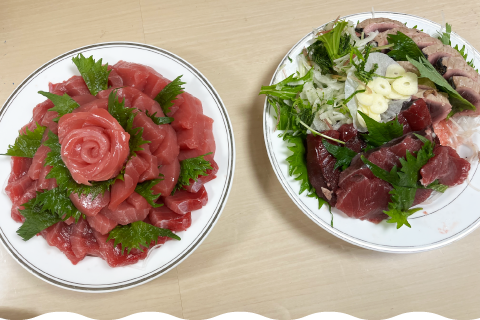
A.One experience that especially remains with me was during a tuna longline fishing exercise. We caught a tuna and then processed it onboard immediately afterward. Witnessing firsthand the moment when a life is taken for food had a profound impact on me and significantly changed the way I think about what we eat. Another memorable aspect of life at sea has been dealing with seasickness. When you spend a long period onboard, your body gradually adapts and becomes less prone to motion sickness. However, after being away from ships for several months, it is not unusual to feel seasick again when you return. In fact, I have been away from ships for quite a while now, so I am a little anxious about my next voyage to the Boso area. (wry laugh)
A.I have a sweet tooth, so one of the first things I usually do after returning to shore is stop by a convenience store and buy some sweet treats. Onboard, foods made with perishable ingredients like fresh whipped cream are generally not available, so I really start to miss them during a voyage. Sometimes I'll also go to a café and take my time enjoying some sweets. That said, the ship does serve ice cream, so with the hot season approaching, that's definitely one of the things I'm looking forward to.
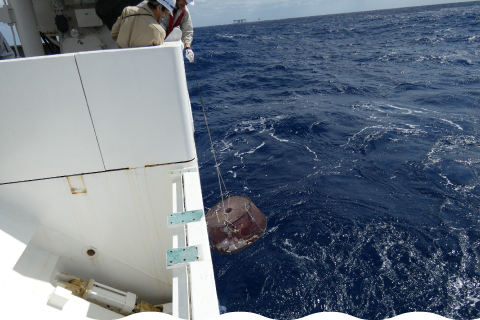
A.The content of the training differs depending on the students' year of study. For third-year university students, who boarded the ship for the first time, the training focused on basic onboard duties. Their main activities included standing navigational watch (lookout duty) and maintaining voyage records. For fourth-year students, the training involved more advanced tasks that are closer to actual professional practice, such as ship handling and maneuvering. In the waters around Okinotorishima, we also conducted squid-fishing operations and carried out ecological research based on the results.
A.I was surprised to see such a striking man-made structure in the middle of the vast ocean. However, once I realized it was Okinotorishima and as we continued sailing around the area, the fact that the region is a part of Japan slowly sank in. From a navigation officer's perspective, Okinotorishima is an important landmark because it is located so far from any other landmass. In that sense, it serves a role similar to a lighthouse, helping mariners navigate. At the same time, the surrounding waters are ringed by coral reefs, which means navigation must be carried out with extreme caution. It is definitely not a place where you can let your guard down.
A.Okinotorishima may be little more than a distant place seen only in textbooks for many people, but it plays a vital role in supporting Japan's vast maritime domain. Last year, during a training voyage, I had the opportunity to see Okinotorishima with my own eyes and experienced firsthand the significance of such a small island. It remains one of the most memorable moments of my career as a navigation officer. Although the profession of navigation officer is not yet widely recognized, I believe there is great value in helping people learn that careers like this exist. If readers of this interview come away thinking, "I didn't know such a job existed," that alone would be meaningful. I would be especially happy if it encourages children to consider it as one of their future career options.


 The official website of the Tokyo Metropolitan Government
 The official website of the Tokyo Metropolitan Government