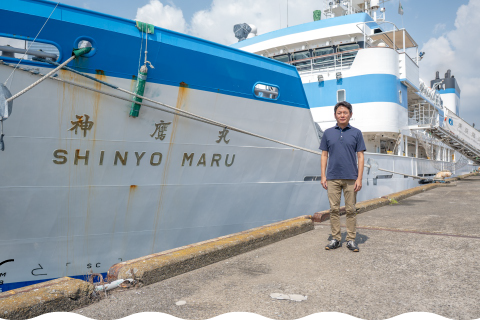
A.I studied at the Faculty of Science, Kyushu University, for my undergraduate and master's degrees. There, I developed an interest in geoscience and undertook research on earthquakes and the Earth's internal structure. For my PhD, I moved to the University of Tokyo to pursue more specialized research. I am currently at Tokyo University of Marine Science and Technology, where I teach courses such as Introduction to Geoscience and Ocean Floor Science to undergraduates. At the graduate level, I teach Ocean Floor Geoscience, which covers more specialized topics related to the seafloor.
A.We went on about three cruises a year both last year and the year before, and we are continuing at the same rate this year. This year, first, we conducted a five-day training cruise off the coast of the Boso Peninsula with students in June as part of a class. Then, in July, we carried out a two-week cruise to conduct a field survey around Okinotorishima, and in October, we plan to go on another five-day cruise off the coast of the Boso Peninsula.
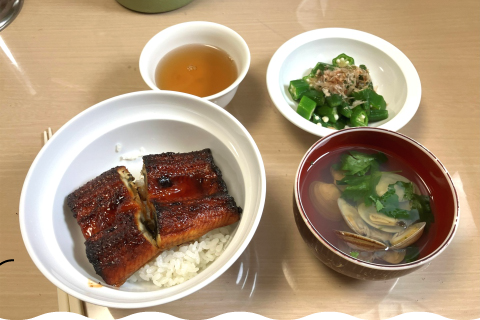
A.One of the things I enjoy is eating. The food prepared on board is delicious, and I always look forward to it. There is also time for something to drink in the evenings, which is another simple pleasure while at sea. I like watching the waves and the scenery as well, so when there's time, I relax to enjoy the view of the sea and the natural beauty of the sunrise and sunset. I've run into some tough spots, though, in the past when, in the middle of the cruise, I ran out of the sweets that I had brought with me as an indulgence. After that, I made sure to bring extra sweets to avoid having the same situation again. Even little things like that can end up as lasting memories of your time on a ship.
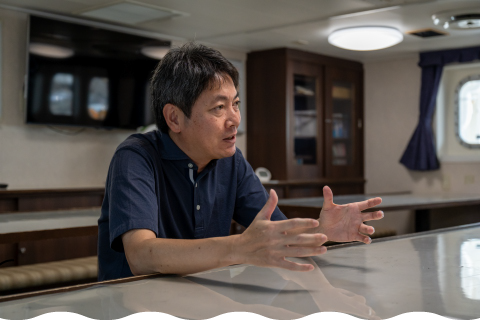
A.In solid-earth geophysics, we are conducting research exploring the solid parts of the Earth through physical phenomena and using seismic waves to investigate the Earth's internal structure and earthquake occurrence patterns. With regard to ocean floor geoscience, in a cruise off the coast of the Boso Peninsula that is planned for October of this year, we will use sound waves from our ship to measure the positions of reference stations installed on the seafloor. By continuing these surveys for many years and tracking the changes, we hope to clarify how the seafloor is moving. What led me to choose these areas as a specialization was the eruption of Mount Unzen Fugen-dake in Nagasaki Prefecture, which happened when I was in high school. Hearing about the eruption during class in high school left me with a strong desire to prevent people losing their lives in a disaster, so I decided to pursue a career in geoscience, which takes the Earth itself as its object of study, and I chose a seismology lab at university. One day, my lab decided to start doing earthquake monitoring in the ocean, and when we were discussing who would do it, my professor suggested to me that, if my grandparents were fishermen, I probably wouldn't get seasick, so why not give it a try? So I decided to take part in the monitoring. Once I actually tried it, I found the monitoring extremely interesting, and I've continued researching seafloor seismology to this day.
A.What most sticks out in my mind is when we monitored the aftershocks immediately after the 2011 Tohoku earthquake. The ocean was a murky brown, and we could see roofs and debris floating in the ocean. The weather got worse during our cruise, so we took refuge in Sendai Bay, where there were many ships from the Self-Defense Force and the Coast Guard. I still remember the sight well. Also, the survey had planned to install seismometers off the coast of Fukushima, but due to the nuclear power plant, we ultimately moved the monitoring area a bit to the north. Installing ocean-bottom seismometers immediately after the earthquake enabled us to more accurately ascertain aftershock activity, and this data was extremely important in inferring what kind of earthquake the 2011 Tohoku earthquake was.
A.The most rewarding thing is that it contributes to future disaster prevention and mitigation. Probing underground structures using seismic waves allows us to simulate the shaking that occurs during an actual earthquake. If the results of such research help even a little bit in disaster prevention, I feel that it is extremely meaningful. The other aspect is pure curiosity. As a researcher, I feel joy whenever something no one knew before is brought to light.
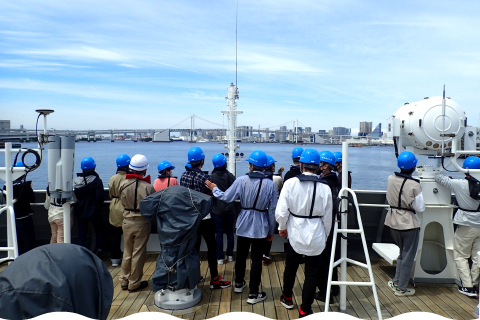
A.I knew that the Tokyo Metropolitan Government was conducting a research project on Okinotorishima and Minamitorishima because of research that Associate Professor Seishiro Furuyama at my university had been conducting without visiting the site since 2024. Then, when there was a call for proposals regarding research that would involve field surveys starting in 2025, there were suggestions within the university about using our own ships and training cruises to conduct the survey, so I decided to apply. For this research project, we investigated both the past and present of Okinotorishima. First, with regard to the past, we aim to elucidate how Okinotorishima was formed along with the underlying volcanic activity. Surveys of seafloor topography and underground structure are also important themes, and we have installed ocean-bottom seismometers to analyze how seismic waves propagate. This will enable us to clarify the geological structure that extends beneath the seafloor. Moreover, coral fossils found on the seafloor around Okinotorishima contain records of past climate fluctuations, and by taking samples and analyzing them, we are exploring the environmental transitions that Okinotorishima went through to become what it is today. Meanwhile, with regard to the present, we are ascertaining the kinds of marine life that inhabit the area around Okinotorishima to explore the potential for future fishery resources. We believe that by conducting regular surveys in the future, we will be able to track changes in the marine environment. We are also investigating the distribution of marine debris floating near Okinotorishima to assess the current state of the marine environment.
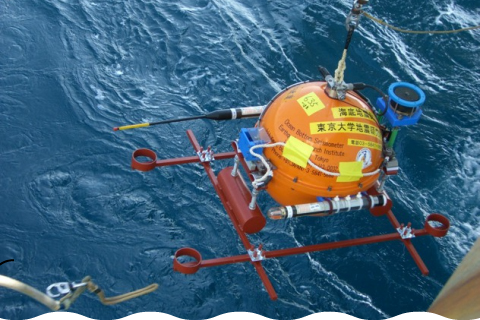
A.First, we hope to elucidate the (past) processes that formed Okinotorishima as it is today. The area around Okinotorishima is a fascinating example of back-arc basin* expansion, whose formation mechanism is still not fully understood. We would also like to ascertain the (present) characteristics of the fishing grounds around Okinotorishima. We believe there is some degree of demand for tourism such as cruises and whale watching around Okinotorishima. This information is indispensable in assessing the conservation and industrial use of Okinotorishima.
*Back-arc basin:A basin that forms behind a subduction zone where an oceanic plate subducts beneath another plate at a trench.
A.Even though people may know the name Okinotorishima, I expect there still aren't that many who recognize the island as a part of Tokyo. We hope to make Okinotorishima known to as many people as possible through this research under the government of Tokyo while promoting the research results. Moreover, at the basis of my own research is the desire to reduce as much as possible the number of lives lost due to disasters. I hope to continue my research into disaster prevention and mitigation in the future.


 The official website of the Tokyo Metropolitan Government